The error message “Content Failed to Load” appears on ChatGPT when the system cannot properly render or retrieve the data needed to generate or display a response. It is one of the more confusing errors because it often shows up without any additional details — especially during long sessions or when handling large content.
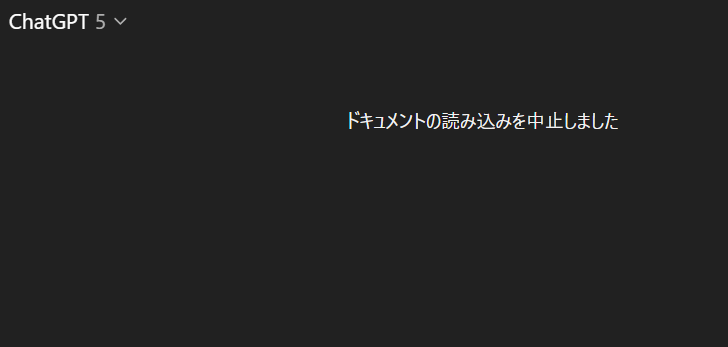
This is Japanese ver massege, but its same as En app Maybe.
This guide explains:
✔ what triggers this error
✔ what it really means
✔ how to fix it immediately
✔ how to prevent it going forward.
■ When does “Content Failed to Load” happen?
Based on reports from user forums, GitHub issues, and community discussions, the error commonly appears under the following circumstances:
● When you send a long or complex message
Large prompts, long code blocks, and massive text inputs can cause ChatGPT to stall.
● When switching between conversation modes
For example: Text ↔ Image generation ↔ File analysis.
● When the session has been open for a long time
Sleep mode, tab suspension, or session timeout can break the internal state.
● When the network connection hiccups
A momentary disconnect interrupts the content retrieval pipeline.
● When ChatGPT tries to load previous messages but fails
This happens especially in conversations with many long exchanges.
● When browser memory is nearly full
Heavy extensions, multiple tabs, or large images can trigger incomplete loading.
■ What the error actually means
“Content Failed to Load” is almost always a client-side loading failure, not a server crash.
It indicates that the ChatGPT interface was unable to fetch or render data required for the response.
This can involve:
1. The browser canceling the request
Memory pressure, tab suspension, or internal timeout interrupts the fetch process.
2. A broken session state
Long-lived conversations often accumulate cached data, causing the UI to fail when loading recent history.
3. Partial network responses
If your device drops connection mid-request, the browser receives incomplete content and reports a failure.
4. Frontend rendering problems
Occasionally triggered by Markdown, images, or code blocks that fail to compile in the UI.
In short:
ChatGPT is working, but your browser stopped the content from arriving.
■ Common environments where users report this error
- Windows 10/11 + Chrome
- macOS + Safari
- VPN + browser → connection resets
- Mobile browsers with tab memory limits
- Browser extensions modifying ChatGPT pages
- Corporate networks with aggressive filtering
This error isn’t specific to any particular OS or user — it’s a broad UI-level issue.
■ How to fix “Content Failed to Load”
1. Refresh the page (most reliable)
In most cases, a simple reload resets the session and ChatGPT loads normally.
2. Clear the last message and resend it
If the failure happens right after a long prompt, delete it, reload, and resend.
3. Switch to a different browser
Chrome is the most common environment for this error.
Edge and Firefox handle memory differently and are often more stable.
4. Disable browser extensions
Especially:
- ad blockers
- script blockers
- ChatGPT extensions
- auto-translation tools
- screen recorder or privacy tools
These often interfere with content loading in the UI.
5. Check your network or turn off VPN
A brief disconnect during message rendering frequently triggers this error.
6. Use the ChatGPT desktop app
The official app (Windows/macOS) avoids most browser-specific loading problems.
7. Restart the browser or device
If memory is fragmented, only a restart resolves the UI failure.
■ If the issue keeps happening
Try these steps:
- Break your message into smaller parts
- Delete old conversation threads (reduces UI load)
- Try the ChatGPT mobile app
- Temporarily disable VPN or corporate proxy
- Upload files one at a time instead of multiple at once
These steps stabilize the rendering environment.
■ Summary
The ChatGPT error “Content Failed to Load” is a UI-side interruption, not a model failure. It usually means:
Your browser or network prevented ChatGPT from fully loading content.
The most frequent causes are:
- long sessions
- large or complex inputs
- browser memory pressure
- unstable connectivity
- aggressive extensions
The fastest fix is:
Refresh → Resend the message.
Moving to the desktop app or breaking inputs into smaller chunks prevents most future occurrences.
